
-

- Find A Provider
-
Services
- Addiction Recovery
- Audiology
- Behavioral Health
- Cardiac Rehabilitation
- Cardiology
- Chiropractic Care
- Colon Cancer Screening
- Dermatology Services
- Diabetes Education
- ER & Urgent Care
- Eye Care
- Family Medicine
- Home Care
- Hospice
- Infusion Therapy
- Internal Medicine
- Laboratory
- Long Term Care Facility
- Men's Health
- Nutrition Services
- Orthopedics
- Pain Management
- Podiatry
- Radiology/Diagnostic Imaging
- Rehabilitation Services
- Respiratory Care
- Senior Care Unit
- Sleep Medicine
- Surgery
- Swing Bed/Transitional Care
- Urology
- Women's Health
- Patients & Visitors
- Facilities & Pharmacy
- About Us
-

A Mammogram Is Important. So Is Knowing Your Normal.
October 9, 2026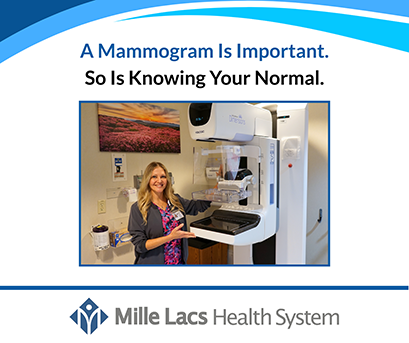
October is Breast Cancer Awareness Month and an important time to talk about mammograms and recommended screening. Mille Lacs Health System offers 3D mammography at its Onamia campus. This technology takes multiple images of the breast from different angles, giving the radiologist a more detailed view of breast tissue.
But breast health doesn’t begin and end with your mammogram. Knowing what’s normal for you matters the other 364 days of the year, too.
You don’t need an elaborate routine to stay aware of changes in your breasts. Simply becoming familiar with how they look and feel can make it easier to recognize when something is different. Pay attention when you’re getting dressed, showering, or looking in the mirror. The goal isn’t to constantly search for something wrong. It’s to notice when something changes.
Changes worth paying attention to include a new lump or firm area in the breast or underarm; swelling or a change in the size or shape of a breast; dimpling or puckering of the skin; redness, scaliness, or thickening of the breast or nipple skin; a nipple that begins turning inward; nipple discharge other than breast milk; or persistent pain in one area.
Most breast changes are not cancer. But if something is new, different, or doesn’t go away, it should be evaluated - even if you recently had a normal mammogram.
Knowing your normal also means understanding that your breasts may not feel exactly the same throughout the month. Hormonal changes during the menstrual cycle can cause breast tissue to become swollen, tender, fuller, or lumpier, particularly before a period. These changes typically improve once the period begins.
After a period, when breasts are usually less swollen and tender, can be a good time to become familiar with how your breast tissue normally feels. Over time, you may recognize your own pattern - and be better able to notice a new lump, thickening, or other change that persists.
Your “normal” can change throughout your lifetime, too. Pregnancy, breastfeeding, menopause, hormone use, weight changes, and aging can all affect how breasts look and feel. The important thing isn’t expecting your breasts to always look or feel exactly the same - it’s becoming familiar enough with your body to recognize a change that is unusual for you.
Not all breast changes are something you can see or feel. Breast density, for example, is determined through mammography. Dense breast tissue can make some cancers more difficult to see on a mammogram and is also associated with an increased risk of breast cancer. Federal regulations require mammography facilities to tell patients whether their breasts are dense or not dense in their results, information that can be considered along with other individual risk factors.
Another common misconception is that breast cancer is primarily a concern for women who have a family history of the disease. Family history does matter and can increase your risk. However, according to the American Cancer Society, most women who develop breast cancer do not have a family history of the disease.
That’s why routine screening and paying attention to changes are important even when breast cancer doesn’t “run in the family.”
Knowing your breasts doesn’t replace mammography, and having a normal mammogram doesn’t replace paying attention to your body. Screening recommendations can vary based on age, personal and family history, and other risk factors, so work with your healthcare provider to determine the screening schedule that’s right for you. If you notice something new or different - even if your last mammogram was normal - don’t wait until your next screening to have it checked.
And breast awareness isn’t only for women. Men have breast tissue and can develop breast cancer, too. According to the Centers for Disease Control and Prevention, about 1 out of every 100 breast cancers diagnosed in the United States is found in a man. A new breast or underarm lump, nipple or skin changes, nipple discharge, or other unusual changes shouldn’t be ignored.
Mammograms remain an important tool for detecting breast cancer early, often before it can be seen or felt. If you’re due for a mammogram, schedule your 3D mammogram with Mille Lacs Health System by calling 320-532-3154.
A mammogram is one important part of breast health. Knowing your normal - and noticing when something changes - matters all year long.